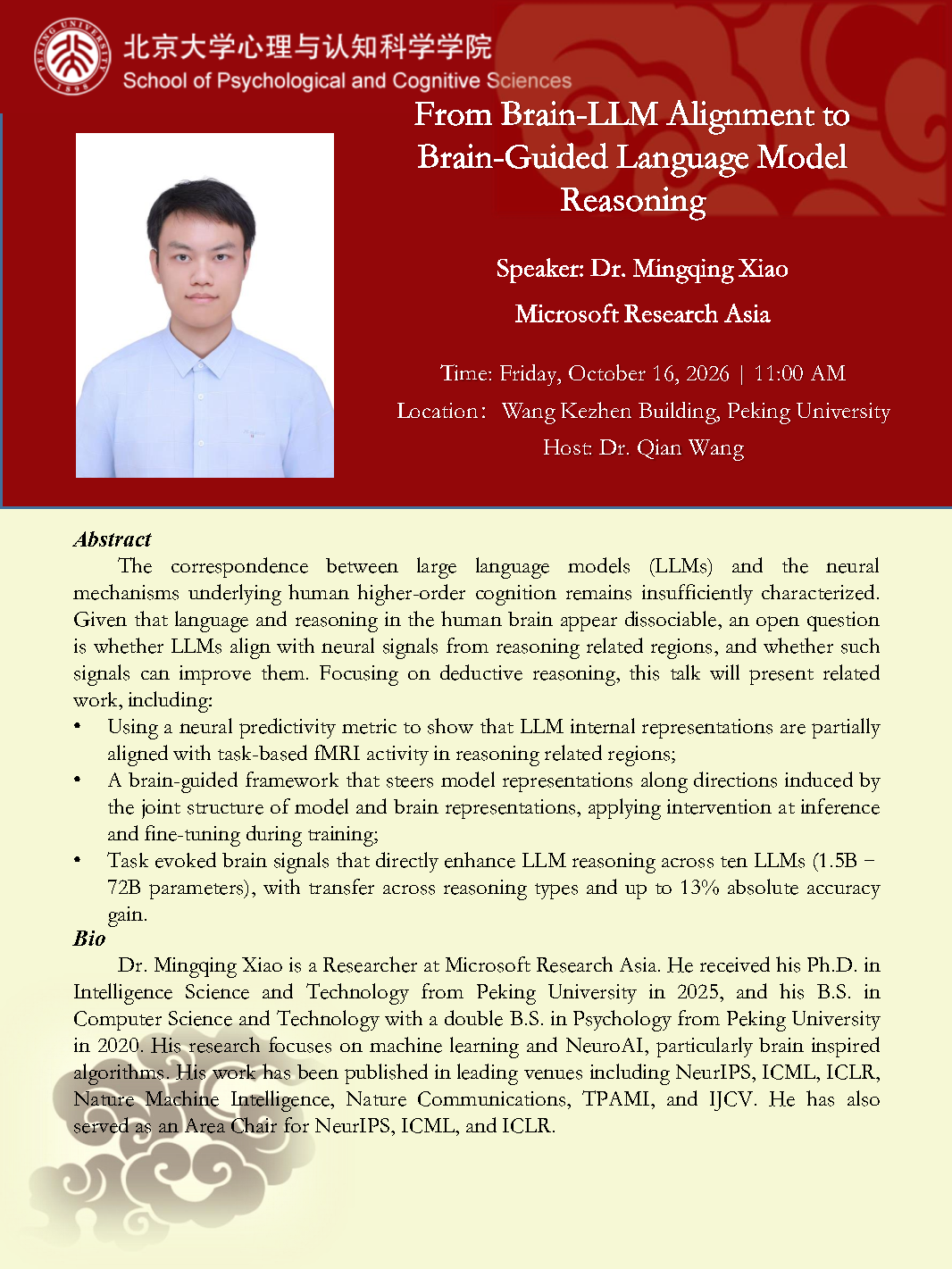
Speaker:Dr. Mingqing Xiao, Microsoft Research Asia
Time: October 16, 11:00 -12:00 AM
Venue:Wangkezhen Building, Room 1113
Host:Dr. Qian Wang
Abstract
The correspondence between large language models (LLMs) and the neural mechanisms underlying human higher-order cognition remains insufficiently characterized. Given that language and reasoning in the human brain appear dissociable, an open question is whether LLMs align with neural signals from reasoning related regions, and whether such signals can improve them. Focusing on deductive reasoning, this talk will present related work, including:
1) Using a neural predictivity metric to show that LLM internal representations are partially aligned with task-based fMRI activity in reasoning related regions;
2) A brain-guided framework that steers model representations along directions induced by the joint structure of model and brain representations, applying intervention at inference and fine-tuning during training;
3) Task evoked brain signals that directly enhance LLM reasoning across ten LLMs (1.5B–72B parameters), with transfer across reasoning types and up to 13% absolute accuracy gain.
Bio
Dr. Mingqing Xiao is a Researcher at Microsoft Research Asia. He received his Ph.D. in Intelligence Science and Technology from Peking University in 2025, and his B.S. in Computer Science and Technology with a double B.S. in Psychology from Peking University in 2020. His research focuses on machine learning and NeuroAI, particularly brain inspired algorithms. His work has been published in leading venues including NeurIPS, ICML, ICLR, Nature Machine Intelligence, Nature Communications, TPAMI, and IJCV. He has also served as an Area Chair for NeurIPS, ICML, and ICLR.
2026-10-08